The 12 Houses in Vedic Astrology: Complete Guide to Bhavas
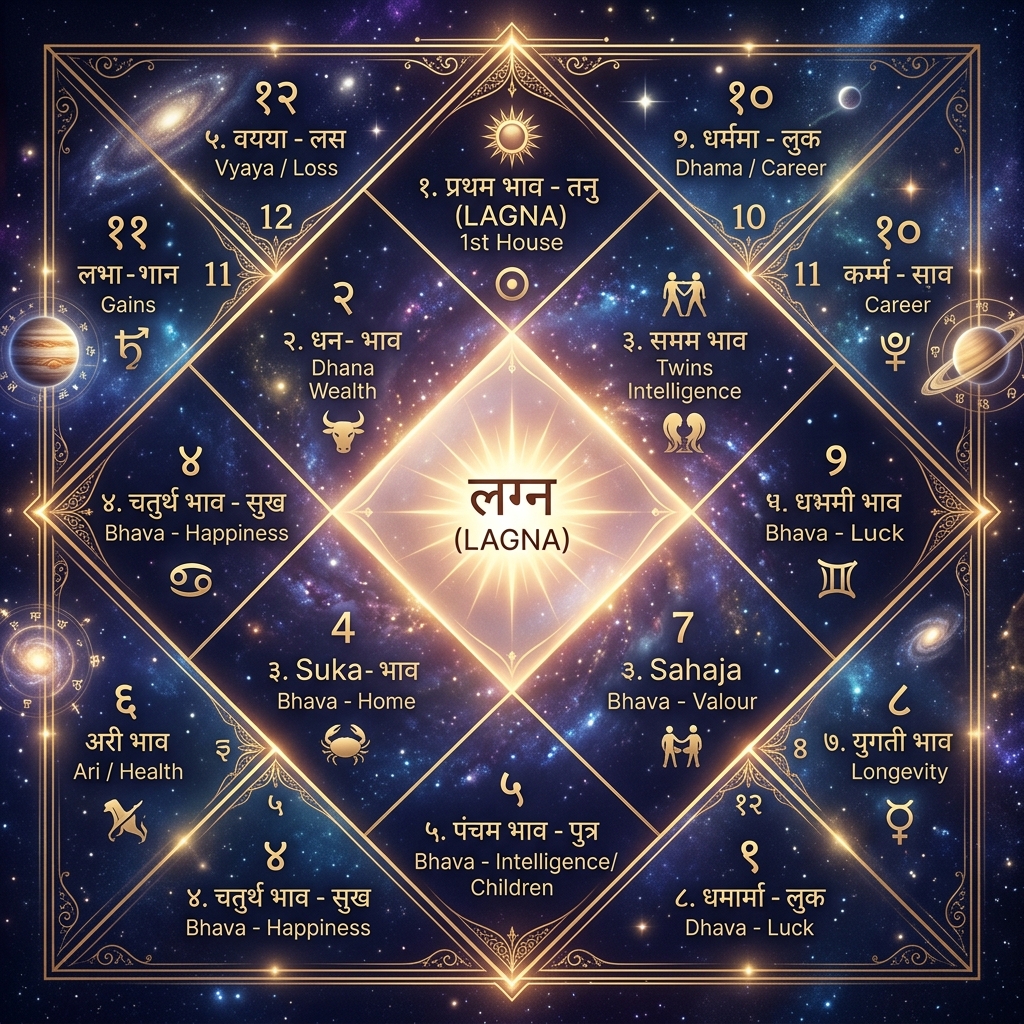
Your Vedic birth chart is divided into 12 sections called Bhavas (houses). Each Bhava rules a specific domain of existence, from your physical body to your career, from your marriage to your liberation. Understanding what each house represents is the foundational step in reading any Vedic horoscope. Every planet's effect in your chart is interpreted through the house it occupies and the houses it rules.
How Houses Are Calculated
Unlike Western astrology, which often uses Placidus or Koch house systems, classical Vedic astrology uses the Whole Sign House system. The sign rising on the eastern horizon at the moment of your birth becomes your 1st house. Each subsequent sign, in order, becomes the next house. This means each house spans exactly 30 degrees and is occupied by one complete zodiac sign.
Cosmic Remedy & Guidance
Example: If Scorpio is rising at your birth, then Scorpio is the 1st house, Sagittarius is the 2nd house, Capricorn is the 3rd house, and so on through all 12 signs.
1st House (Lagna / Ascendant): Self, Body, and Personality
The 1st house is the most important house in the chart. It represents you: your physical body, overall health, personality, temperament, and the lens through which you experience life. The sign rising here, and its ruling planet, colors everything in your chart. A strong 1st house lord means vitality, resilience, and a clearly defined identity.
- •Rules: Physical body, appearance, vitality, personality, self-image, beginnings
- •Body part: Head and brain
- •Strong planets here: Sun and Mars give vitality; Jupiter gives wisdom; Moon gives sensitivity
- •Weak planets here: Saturn slows the body; Ketu brings detachment from self
2nd House (Dhana Bhava): Wealth, Family, and Speech
The 2nd house governs your accumulated wealth, family of origin, voice, food habits, and face. It is also a Maraka (death-inflicting) house, meaning planets here can indicate significant life events during their Dasha periods. Jupiter and Venus in the 2nd house are classic wealth indicators.
- •Rules: Savings, bank balance, early family, speech, face, right eye
- •Strong planets: Jupiter (wealth and wisdom in speech), Venus (beautiful voice, material comfort)
- •Challenging planets: Rahu or Saturn may indicate irregular income or difficult family dynamics
3rd House (Sahaja Bhava): Courage, Siblings, and Communication
The 3rd house governs courage (Parakrama), younger siblings, short travels, writing, skills, and the hands. Mars is the natural karaka (significator) of this house. A strong 3rd house gives initiative, entrepreneurial drive, and the ability to take bold action.
- •Rules: Courage, initiative, siblings, neighbors, short journeys, media, writing
- •Body part: Arms, hands, shoulders, lungs
- •Strong planets: Mars gives courage; Mercury gives communication skills
4th House (Sukha Bhava): Home, Mother, and Inner Peace
The 4th house is the foundation of your private world: home, homeland, mother, vehicles, property, and emotional security. The Moon is the natural karaka. A strong 4th house indicates a happy domestic life, a nurturing relationship with the mother, and real estate prosperity.
- •Rules: Home, property, mother, vehicles, inner happiness, education, land
- •Body part: Heart and chest
- •Strong planets: Moon (comfort and nurturing); Venus (luxury home); Jupiter (wise and spiritual home)
5th House (Putra Bhava): Children, Intelligence, and Past-Life Merit
The 5th is one of the most auspicious houses in the chart, a Trikona (trinal) house. It governs children, creativity, romance, higher intelligence (Buddhi), speculation, and Purva Punya (merit from past lives). Jupiter is the natural karaka. A strong 5th house creates scholars, artists, and loving parents.
- •Rules: Children, intelligence, creativity, romance, stock market, mantras, past-life merit
- •Body part: Stomach and upper abdomen
- •Strong planets: Jupiter (wisdom and children); Sun (leadership and authority); Venus (creative arts)
6th House (Ripu Bhava): Health, Enemies, and Service
The 6th is a Dusthana (malefic) house but also an Upachaya (growing) house. It governs disease, enemies, debts, obstacles, litigation, and service. Malefic planets like Mars, Saturn, and Rahu actually do well here. They destroy enemies and obstacles. Strong 6th house placements are common in doctors, lawyers, soldiers, and athletes.
- •Rules: Health and disease, enemies, debts, daily work, service, pets, maternal relatives
- •Body part: Intestines, lower abdomen
- •Strong planets for this house: Mars (conquers enemies); Saturn (endurance under pressure)
7th House (Yuvati Bhava): Marriage, Partnerships, and Business
The 7th house is the most studied house after the Lagna. It governs marriage, life partner, business partnerships, legal contracts, and foreign travel. Venus is the natural karaka for this house. The 7th lord's placement reveals the type of partner you attract and the quality of your significant relationships.
- •Rules: Spouse, marriage, partnerships, public image, legal agreements, lower abdomen
- •Natural karaka: Venus (partnerships); Jupiter for females and Venus for males as marriage significators
- •Strong planets: Jupiter indicates a wise, generous partner; Venus a beautiful one
- •Challenging: Saturn in the 7th can delay marriage; Rahu can bring unconventional partnerships
8th House (Mrityu Bhava): Transformation, Death, and Hidden Wealth
The 8th is the most misunderstood house in Vedic astrology. It governs transformation, sudden change, secrets, occult knowledge, inheritance, insurance, and the mysteries of birth and death. It is a Dusthana house but also the house of longevity. Strong 8th house placements are common in researchers, surgeons, astrologers, and occultists.
- •Rules: Death and longevity, hidden assets, inheritance, occult, partner's money, research
- •Body part: Genitals, excretory organs
- •Challenging but transformative: Planets here force a deep confrontation with life's impermanence
9th House (Dharma Bhava): Fortune, Father, and Higher Purpose
The 9th house is the luckiest house in the chart. It is a Trikona ruled by the principle of Dharma, or righteous duty. It governs fortune, the father, higher education, long journeys, philosophy, religion, gurus, and divine grace. Jupiter rules this house naturally. A strong 9th house is the mark of someone blessed by circumstances and supported by unseen forces.
- •Rules: Luck, father, gurus, religion, philosophy, long journeys, higher education, law
- •Body part: Hips and thighs
- •Strong planets: Jupiter (wisdom, faith); Sun (noble father); Venus (grace and devotion)
10th House (Karma Bhava): Career, Status, and Public Life
The 10th is the most visible house in the chart. It governs your career, profession, reputation, social status, government, and karma (action in the world). It is a Kendra (angular) house. Planets placed here become highly visible and powerfully activated. The Sun, Mercury, Jupiter, and Saturn do exceptionally well in the 10th.
- •Rules: Career, profession, fame, government, boss, public image, karma
- •Body part: Knees
- •Strong planets: Sun (leadership); Saturn (disciplined career success); Jupiter (teaching, law, wisdom professions)
11th House (Labha Bhava): Gains, Desires, and Social Networks
The 11th is the house of gains, income from profession, fulfillment of desires, elder siblings, friends, and social networks. As an Upachaya house, malefic planets like Saturn, Mars, and Rahu actually grow stronger here over time. A strong 11th house is essential for large income and the achievement of life goals.
- •Rules: Income, gains, desires, elder siblings, friends, social circles, left ear
- •Strong planets: Saturn (steady, large gains through discipline); Jupiter (gains through dharma and knowledge)
12th House (Vyaya Bhava): Loss, Liberation, and Foreign Lands
The 12th is the final house, a Dusthana governing expenditure, loss, foreign settlement, hospitals, prisons, sleep, dreams, and Moksha (spiritual liberation). Ketu and Jupiter are the natural karakas for spiritual liberation. Strong 12th house placements are common among those who live abroad, work in hospitals, devote themselves to spiritual practice, and those who attain Moksha.
- •Rules: Losses, expenditure, foreign lands, isolation, spirituality, bed pleasures, left eye, Moksha
- •Body part: Feet
- •Strong planets for spirituality: Ketu (detachment); Jupiter (grace and liberation); Saturn (renunciation)
House Groups: Kendra, Trikona, Dusthana, and Upachaya
Houses are grouped into categories that determine their fundamental nature. Understanding these groups is essential for advanced chart interpretation:
- •**Kendra (Angular houses 1, 4, 7, 10)**: The four pillars. Planets here are highly activated and influential.
- •**Trikona (Trinal houses 1, 5, 9)**: The most auspicious houses. They carry dharmic energy and past-life merit.
- •**Dusthana (Difficult houses 6, 8, 12)**: Houses of obstacles, transformation, and hidden realms. Not evil, but transformative.
- •**Upachaya (Growing houses 3, 6, 10, 11)**: Houses that improve with time. Malefics do well here.
- •**Maraka (Death-inflicting houses 2, 7)**: Lords of these houses can trigger significant life events in their Dasha.
The most powerful planets in a chart are those that rule both a Kendra and a Trikona simultaneously. For example, for a Scorpio Ascendant, Jupiter rules the 2nd (Sagittarius) and 5th (Pisces). When a Trikona lord sits in a Kendra, it creates Raja Yoga, one of the most powerful combinations for success and prosperity.
Frequently Asked Questions
What are the 12 houses in Vedic astrology?
The 12 houses (Bhavas) in Vedic astrology represent 12 different areas of life: 1st (self and body), 2nd (wealth and family), 3rd (courage and siblings), 4th (home and mother), 5th (children and intelligence), 6th (health and enemies), 7th (marriage and partnerships), 8th (transformation and inheritance), 9th (fortune and father), 10th (career and status), 11th (gains and desires), 12th (losses and liberation).
Which house represents marriage in Vedic astrology?
The 7th house is the primary house of marriage and partnerships in Vedic astrology. The 2nd house (family), 5th house (romance and love), and 11th house (fulfillment of desires) are also analyzed for a complete marriage prediction. The Navamsha (D-9) divisional chart is specifically studied for marriage quality.
What does it mean to have no planets in a house?
An empty house is not bad or inactive. The lord of that house (the planet that rules the sign occupying that house) carries the house's energy wherever it is placed. For example, if your 7th house is empty but its lord is strongly placed in the 1st house, marriage is still an important part of your identity and self-expression.
What are the Kendra and Trikona houses?
Kendra houses (1st, 4th, 7th, 10th) are the pillars of the chart. They represent the core domains of life: self, home, relationships, and career. Trikona houses (1st, 5th, 9th) are the most auspicious. They represent dharma, fortune, and past-life merit (Purva Punya). Planets ruling both Kendra and Trikona houses are the most powerful in any chart.