How to Read Your Vedic Birth Chart: A Complete Beginner's Guide
A Vedic birth chart, called a Kundali, Janam Patri, or Janma Kundali, is a snapshot of the sky at the precise moment you took your first breath. It shows where each of the nine Vedic planets was positioned across the twelve zodiac signs and twelve houses. Learning to read it is like learning a new language. Complex at first, but deeply logical once you understand the grammar. This guide gives you that grammar.
Step 1: Generate Your Free Birth Chart
Before you can read anything, you need an accurate chart. Go to Anantrix and enter your date of birth, exact time of birth (from your birth certificate if possible), and place of birth. The system will calculate your Vedic birth chart using Swiss Ephemeris data with Lahiri Ayanamsha.
Cosmic Remedy & Guidance
Birth time accuracy matters: A 4-minute error can shift your Ascendant by 1 degree. For precise house readings, aim for a birth time accurate to within 10 minutes. If you don't know your birth time, use 12:00 noon as a starting point, but know that Ascendant and house readings will be approximate.
Step 2: Understand the Chart Format
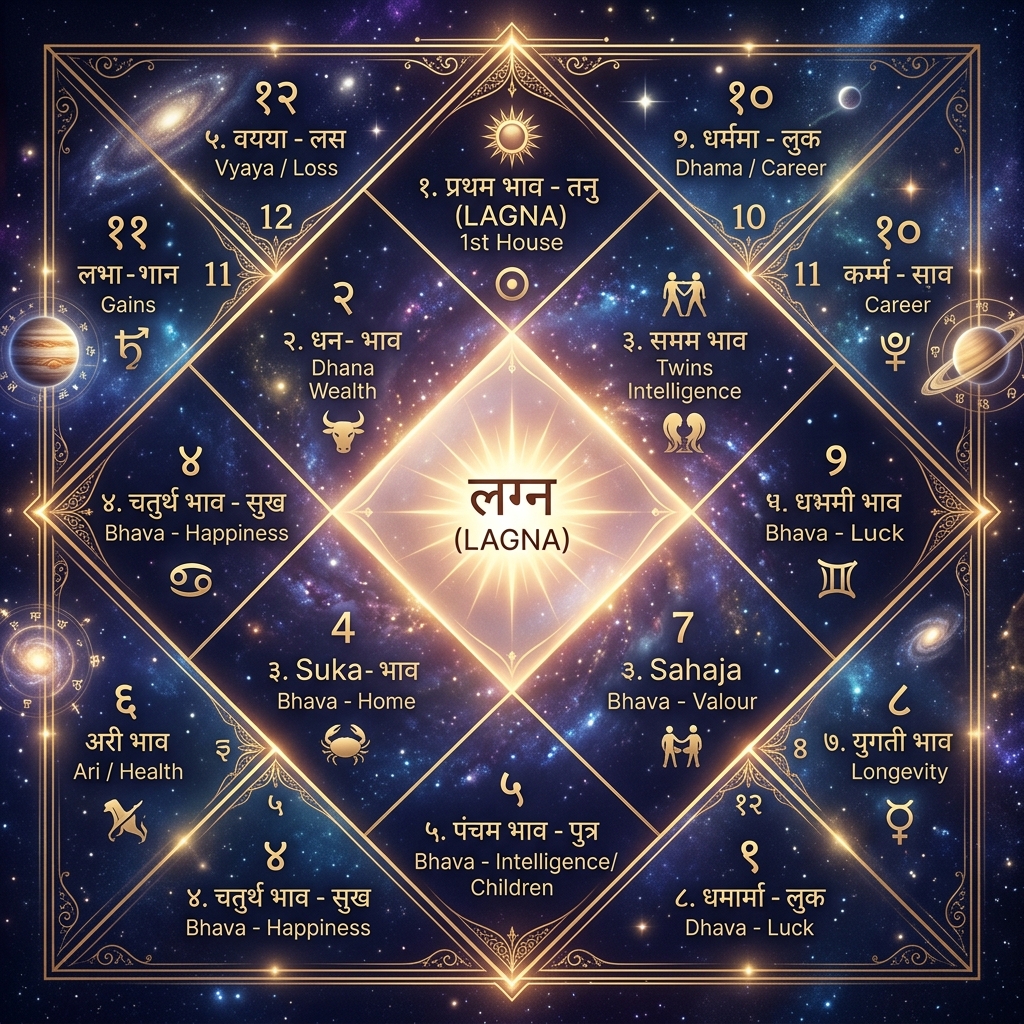
Vedic charts come in two main visual formats: North Indian (diamond-shaped, fixed house positions, Ascendant always at the top) and South Indian (square grid, fixed sign positions, Aries always the top-left box). Both encode the same information differently. Anantrix uses the North Indian format by default.
In the North Indian chart, the topmost diamond is always the 1st house (Lagna). Moving clockwise, each diamond is the next house: 2nd house is upper-right, 3rd house is right, 4th house is lower-right, 5th house is bottom-right, 6th house is lower-left, and so on. The number written inside each house is the zodiac sign occupying that house.
Step 3: Identify Your Ascendant (Lagna)
The Ascendant (Lagna) is the most important point in the chart. It is the zodiac sign that was rising on the eastern horizon at the moment and place of your birth. Everything in the chart is interpreted relative to the Lagna. It sets the house numbering, determines which planet rules which house, and colors your physical appearance, temperament, and how you experience life.
- •1 = Aries Lagna (Mesh), ruled by Mars
- •2 = Taurus Lagna (Vrishabha), ruled by Venus
- •3 = Gemini Lagna (Mithuna), ruled by Mercury
- •4 = Cancer Lagna (Karka), ruled by Moon
- •5 = Leo Lagna (Simha), ruled by Sun
- •6 = Virgo Lagna (Kanya), ruled by Mercury
- •7 = Libra Lagna (Tula), ruled by Venus
- •8 = Scorpio Lagna (Vrishchika), ruled by Mars
- •9 = Sagittarius Lagna (Dhanu), ruled by Jupiter
- •10 = Capricorn Lagna (Makara), ruled by Saturn
- •11 = Aquarius Lagna (Kumbha), ruled by Saturn
- •12 = Pisces Lagna (Meena), ruled by Jupiter
Step 4: Identify Where Each Planet is Placed
Each planet in your chart is placed in one of the 12 houses. The position tells you which life area that planet's energy flows into. Planets are written in abbreviated form in the house box:
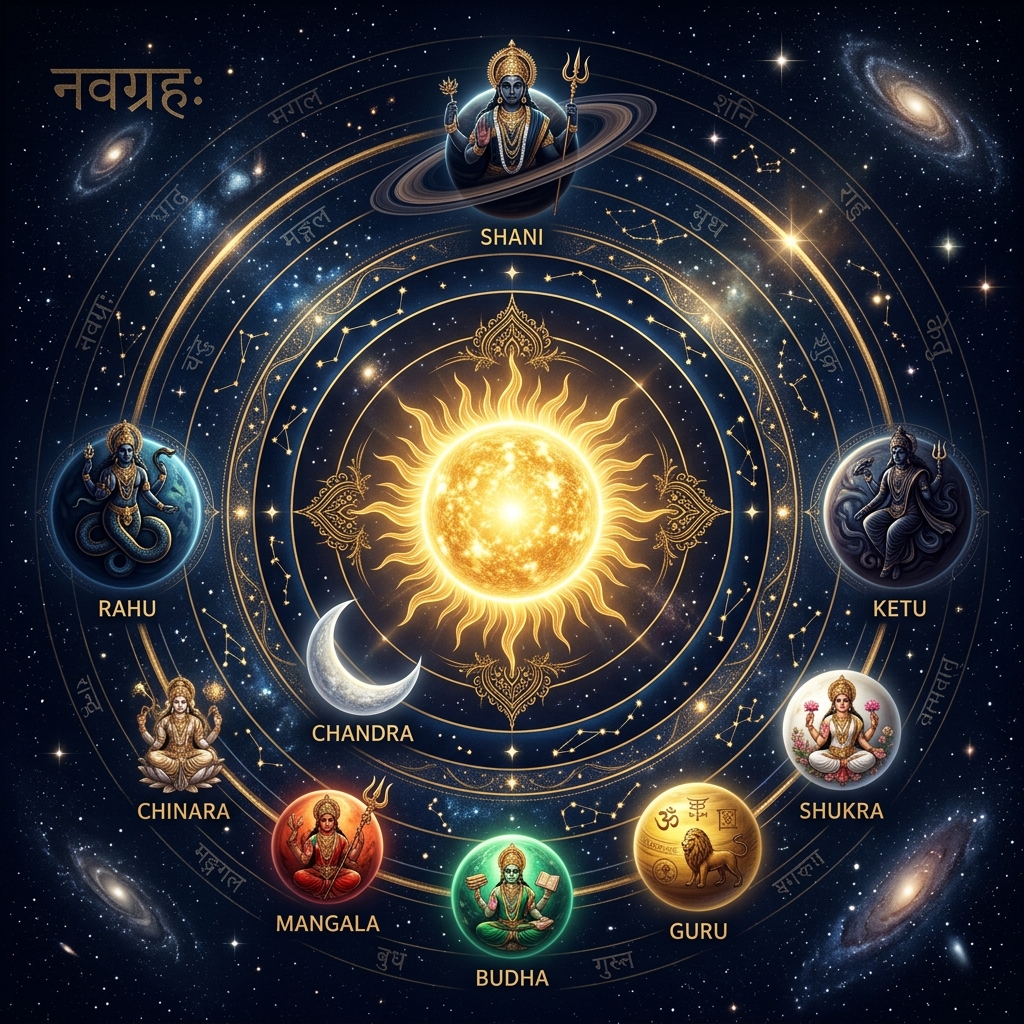
- •**Su** = Sun (Surya), soul, father, authority, government
- •**Mo** = Moon (Chandra), mind, mother, emotions, public
- •**Ma** = Mars (Mangal), energy, brothers, property, courage
- •**Me** = Mercury (Budha), intellect, speech, business, skin
- •**Ju** = Jupiter (Guru / Brihaspati), wisdom, children, wealth, guru
- •**Ve** = Venus (Shukra), relationships, beauty, creativity, luxury
- •**Sa** = Saturn (Shani), discipline, delays, karma, servants
- •**Ra** = Rahu (North Node), obsession, foreign matters, innovation, amplification
- •**Ke** = Ketu (South Node), detachment, past life karma, spirituality, moksha
Step 5: Check Each Planet's Dignity
Once you know where a planet is, the next question is: how strong is it? A planet's strength (Bala) depends significantly on its dignity, that is, whether it is in a comfortable, uncomfortable, or peak state in that sign.
- •**Own sign (Swa)**: Planet is in a sign it rules. Strong, confident, natural expression. Example: Mars in Aries or Scorpio.
- •**Exaltation (Uccha)**: Planet is at peak strength. Example: Moon in Taurus, Jupiter in Cancer, Sun in Aries.
- •**Moolatrikona**: Second best after exaltation. Example: Mars in Aries (1 to 18 degrees), Sun in Leo (0 to 20 degrees).
- •**Friendly sign**: Planet is comfortable. Moderate strength.
- •**Neutral sign**: Neither comfortable nor uncomfortable.
- •**Enemy sign**: Planet is uncomfortable and constrained in expression.
- •**Debilitation (Neecha)**: Planet is at its weakest. Example: Moon in Scorpio, Jupiter in Capricorn, Saturn in Aries.
Step 6: Identify the House Lords
Each of the 12 houses is owned by the planet that rules the sign occupying that house. For example, if your 7th house contains Gemini (sign 3), then Mercury rules your 7th house. Mercury is your 7th house lord. Where Mercury is placed in your chart shows you how and where your marriage energy expresses itself.
Cosmic Remedy & Guidance
Key principle: Even if a house is empty with no planets, it is not inactive. The lord of that house carries that house's themes into whichever house it occupies. An empty 7th house with its lord in the 10th means marriage connects deeply to career. You may meet your partner through work.
Step 7: Look for Yogas (Planetary Combinations)
Classical Jyotish has identified hundreds of Yogas, specific planetary configurations that produce distinct life outcomes. Here are the most important ones to check in your chart:
- •**Raja Yoga**: A Kendra lord (1, 4, 7, 10) combined with a Trikona lord (1, 5, 9). Indicates authority, status, and success.
- •**Dhana Yoga**: Lords of 2nd, 5th, 9th, and 11th houses connected. Indicates wealth accumulation.
- •**Gajakesari Yoga**: Jupiter in Kendra from Moon. Excellent for intelligence, wisdom, and social respect.
- •**Panch Mahapurusha Yoga**: Mars, Mercury, Jupiter, Venus, or Saturn in own sign or exaltation in a Kendra. Creates exceptional traits in that planet's domain.
- •**Neecha Bhanga Raja Yoga**: A debilitated planet whose debilitation is cancelled. Often produces extraordinary compensatory results.
Step 8: Find Your Current Dasha Period
After reading the static chart, the next crucial layer is when. The Vimshottari Dasha system tells you which planet is currently running its period in your life. During a planet's Mahadasha (major period), that planet's house position, sign dignity, and aspects become the dominant influences on your life. A Jupiter Mahadasha with Jupiter in the 9th house in its own sign (Sagittarius) is extraordinarily fortunate. Expect luck, foreign travel, higher education, and spiritual growth during that stretch.
Your current Mahadasha and Antardasha (sub-period) are shown in your Anantrix dashboard. Combine the Dasha analysis with the birth chart reading for complete life insights.
Frequently Asked Questions
What information do I need to generate a Vedic birth chart?
You need three pieces of information: your exact date of birth, your exact time of birth (as precise as possible, because even 5 minutes matters for the Ascendant), and your place of birth. The time is the most critical variable because it determines your Lagna (Ascendant) and the entire house framework of your chart.
How do I find my Ascendant (Lagna) in a Vedic birth chart?
In the North Indian chart style, the Ascendant is the number in the topmost diamond (or the house labeled 1). In the South Indian style, the Ascendant is marked with a diagonal line or the word Asc. The number corresponds to the zodiac sign: 1 is Aries, 2 is Taurus, 3 is Gemini, and so on up to 12 for Pisces.
What does it mean when a planet is exalted or debilitated?
Every planet has one sign where it is strongest (exaltation, or Uccha) and one where it is weakest (debilitation, or Neecha). For example, the Sun is exalted in Aries and debilitated in Libra. An exalted planet delivers its qualities at maximum strength. A debilitated planet struggles to express itself clearly, though debilitation can be cancelled (Neecha Bhanga) under certain conditions, often resulting in powerful compensatory results.
What is a Yoga in Vedic astrology?
A Yoga is a specific planetary combination in the birth chart that produces a distinct result. There are hundreds of Yogas in classical Jyotish. Common ones include: Raja Yoga (combinations for authority and success), Dhana Yoga (wealth combinations), and Panch Mahapurusha Yogas (five configurations involving Mars, Mercury, Jupiter, Venus, or Saturn in specific conditions that create exceptional individuals).