Rahu & Ketu: The Karmic Axis of Obsession and Liberation
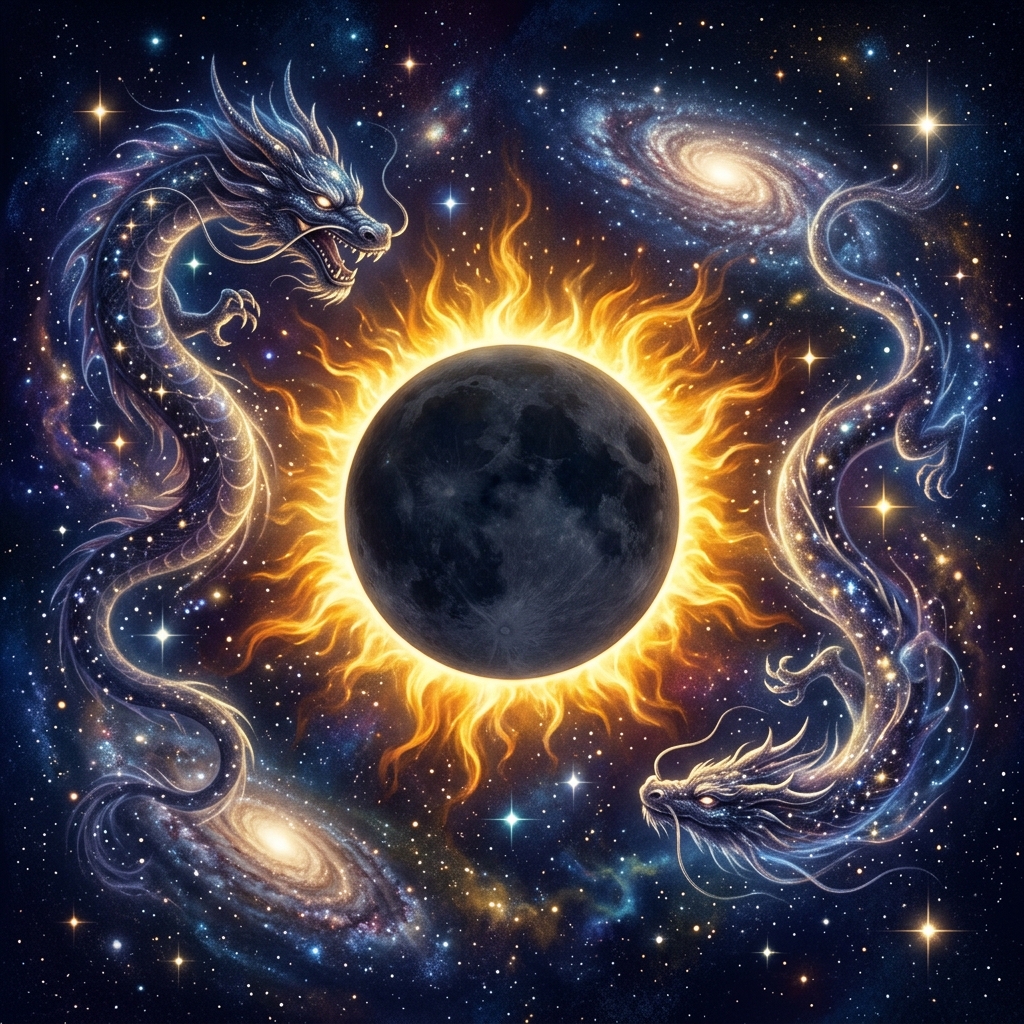
In Vedic astronomy, there are nine planets (Navagrahas). Seven are physical celestial bodies, but the remaining two—Rahu and Ketu—have no physical mass. They are mathematical points of intersection where the Moon's orbit crosses the Earth's path around the Sun. Despite being shadow planets (Chhaya Grahas), they exert the most powerful psychological influence in a horoscope.
Rahu and Ketu represent the karmic axis of the soul. Placed exactly 180 degrees apart, they form a cosmic tug-of-war in your birth chart: one end pulls you toward material ambition and obsession, while the other pulls you toward detachment and spiritual release.
The Myth of Swarbhanu
To understand their behavior, we must revisit the ancient Puranic story of the churning of the ocean (Samudra Manthan). When the nectar of immortality (Amrit) emerged, a demon named Swarbhanu disguised himself as a deva to drink it. The Sun and Moon spotted the deception and alerted Lord Vishnu, who severed the demon's head with his Sudarshana Chakra.
However, because Swarbhanu had already swallowed a drop of the nectar, both parts of his body remained alive. The head became Rahu, and the headless body became Ketu. This myth dictates their astrological traits:
- •Rahu (The Head): Possesses eyes, ears, and a mouth, but no stomach. He can see, hear, and consume, but can never be satisfied. Wherever Rahu sits in your chart represents an area of insatiable desire, obsession, and ambition.
- •Ketu (The Body): Has a body but no head, eyes, or mouth. He cannot see the material world and has no interest in consuming it. Wherever Ketu sits represents an area of natural mastery (past-life experience), but also deep detachment, isolation, or loss.
The Karmic Axis in Your Chart
The houses occupied by Rahu and Ketu reveal your evolutionary trajectory. For instance, if you have Rahu in the 4th house and Ketu in the 10th house:
Your Ketu in the 10th house indicates that you have already mastered career dynamics, social status, and public responsibility in past lives. You might find public life natural but ultimately unsatisfying. Your Rahu in the 4th house shows that your current soul lesson lies in developing domestic peace, emotional security, and focusing on your home environment.
"Rahu points to the future territory you must conquer, while Ketu represents the anchor of past experiences you must eventually release."
Balancing the Tug-of-War
The key to managing this axis is balance. If you focus entirely on Rahu's material obsession, you will experience anxiety and burnout. If you retreat entirely into Ketu's detachment, you will ignore your current life duties.
Cosmic Remedy & Guidance
Balancing Ritual: Spiritually, Ketu is governed by Lord Ganesha, and Rahu is connected to Goddess Durga. Worshipping Ganesha helps you tap into Ketu's wisdom and structure, while practicing meditation keeps Rahu's obsessive thoughts in check. Treat Rahu as a project manager and Ketu as the spiritual advisor.
By locating the Rahu-Ketu axis in your birth chart, you can understand your natural impulses, resolve inner conflicts, and move forward on your path of growth.
Frequently Asked Questions
Are Rahu and Ketu physical planets?
No. They are mathematically calculated shadow planets (Chhaya Grahas). They represent the intersection points where the Moon's orbit crosses the ecliptic (the Sun's apparent path).
What does Rahu represent?
Rahu represents insatiable material desire, innovation, foreign things, obsession, and the new karmic direction your soul wants to explore in this lifetime.
What does Ketu represent?
Ketu represents past-life mastery, spiritual detachment, isolation, occult knowledge, and ultimate liberation (moksha).