Vedic Astrology vs Western Astrology: The Complete Difference Explained
If you have ever looked up your horoscope and found a completely different Sun sign in a Vedic app compared to a Western one, you are not alone. The confusion is real. So is the gap between the two systems. Understanding why they differ is not just an academic exercise. It determines the accuracy of every prediction made about your life.
The Core Divide: Sidereal vs. Tropical Zodiac
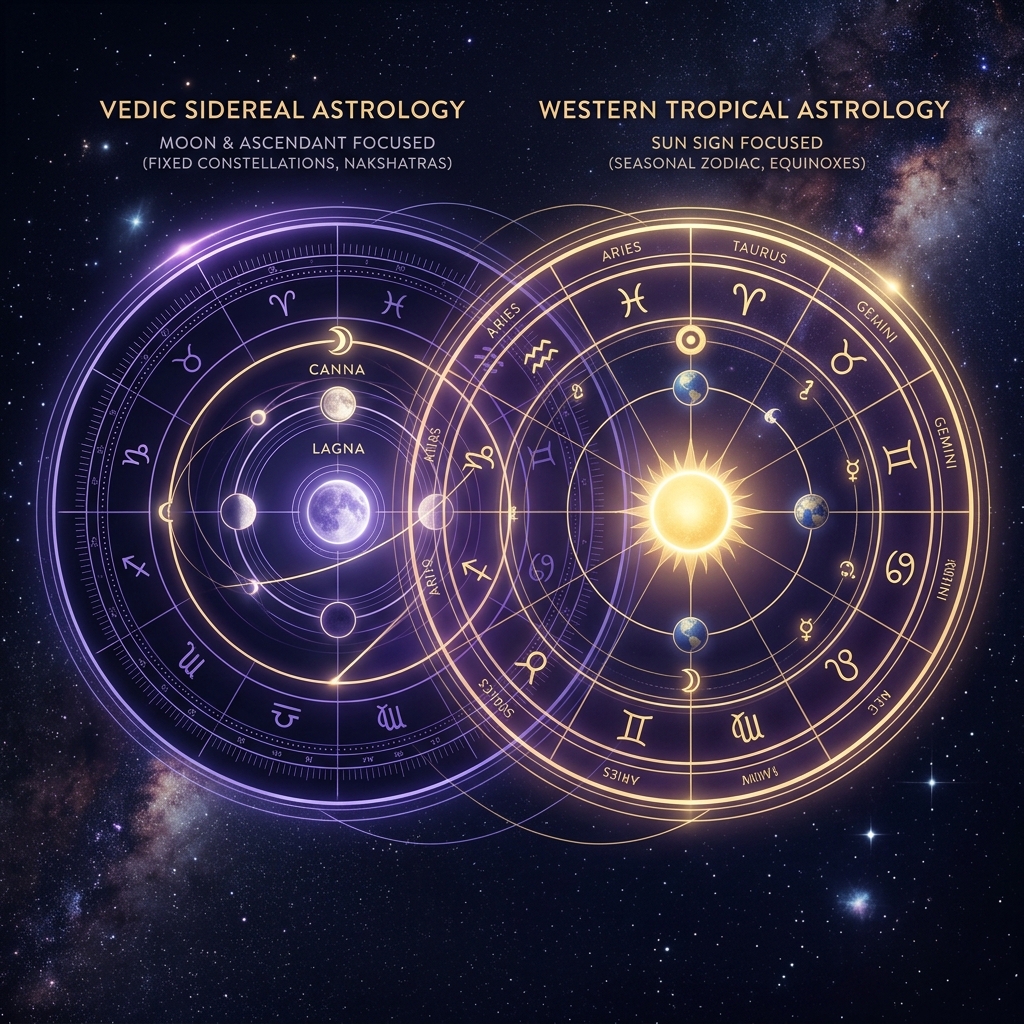
This single distinction underpins every other difference. Vedic astrology (Jyotish) uses the sidereal zodiac, which is fixed to the actual positions of the constellations in the sky. Western astrology uses the tropical zodiac, which is fixed to the seasons. In the Western system, 0 degrees Aries is always set to the Spring Equinox.
Around 2,000 years ago, both systems agreed. The constellations and the seasons were roughly aligned. But Earth's axis wobbles over a 26,000-year cycle called the Precession of the Equinoxes. Over the millennia, the two zodiacs drifted apart by approximately 23 to 24 degrees. That is nearly one full zodiac sign.
Cosmic Remedy & Guidance
Practical impact: If Western astrology says your Sun is at 5 degrees Scorpio, Vedic astrology places it at approximately 11 degrees Libra. Most people with a Western Sun sign will find their Vedic Sun sign is one sign earlier.
What is Ayanamsha?
Ayanamsha is the technical term for the angular gap between the sidereal and tropical starting points. Several values exist, but the Lahiri Ayanamsha (Chitrapaksha) is the most widely used. It is the official standard adopted by the Indian government's Rashtriya Panchang. In 2026, Lahiri Ayanamsha is approximately 24 degrees and 7 minutes, meaning Vedic charts place planets about 24 degrees behind their Western positions.
Emphasis: Sun Sign vs. Ascendant and Moon
In Western astrology, the **Sun sign** is the centerpiece. When someone says "I am a Scorpio," they mean their Sun is in Scorpio. In Vedic astrology, the **Lagna (Ascendant)** is the primary anchor of the chart. It changes approximately every two hours, making it far more personalized. The **Moon sign (Rashi)** is often more important than the Sun sign in Jyotish, because it shows how you process experience emotionally and mentally.
- •**Vedic priority**: Lagna (Ascendant) > Moon Sign (Rashi) > Sun Sign
- •**Western priority**: Sun Sign > Rising Sign > Moon Sign
Planets Used: Classical Nine vs. Modern Ten
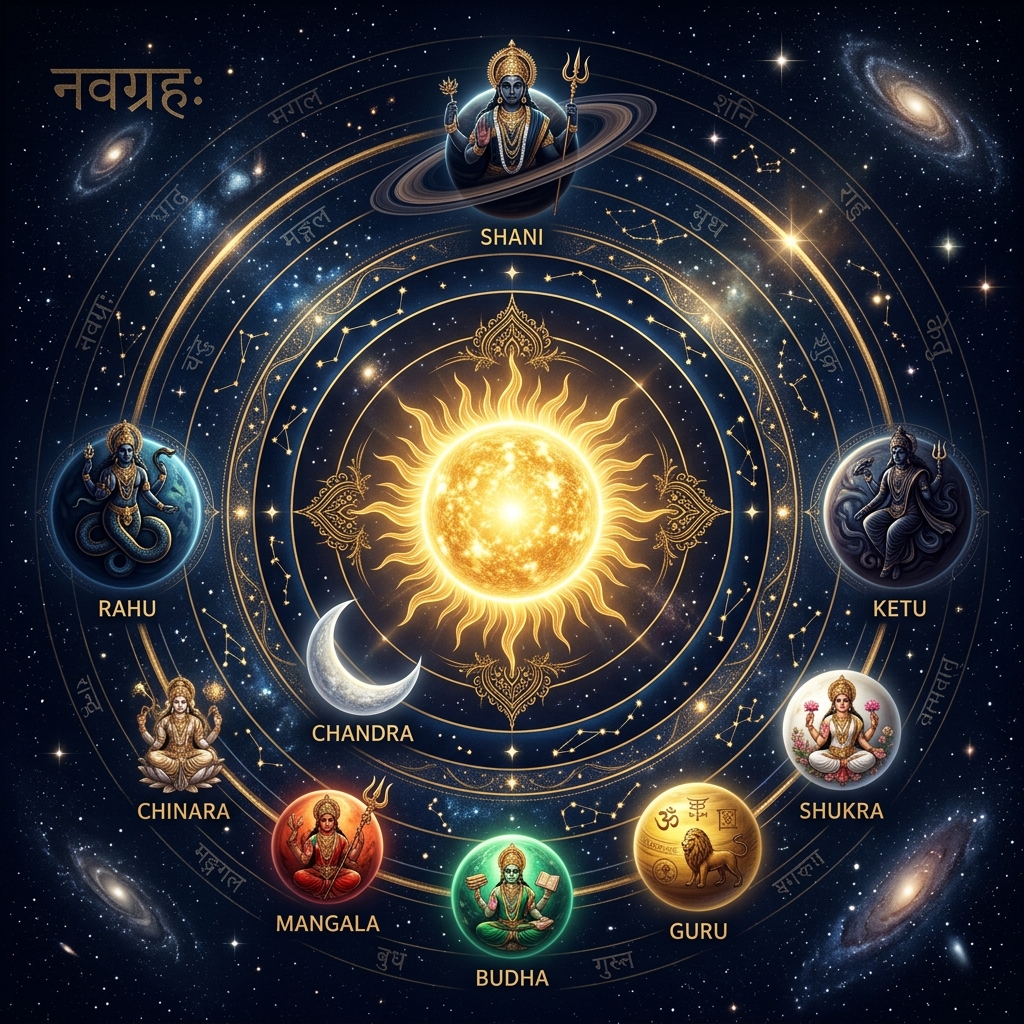
Traditional Jyotish works with the Navagraha: nine celestial bodies including Sun (Surya), Moon (Chandra), Mars (Mangal), Mercury (Budha), Jupiter (Guru), Venus (Shukra), Saturn (Shani), Rahu (North Node), and Ketu (South Node). Uranus, Neptune, and Pluto are not part of the classical system.
Western astrology includes Uranus (discovered 1781), Neptune (1846), and Pluto (1930). These outer planets are central to psychological and generational interpretation in Western practice. Some contemporary Vedic astrologers experiment with outer planets, but classical Jyotish does not require them.
Predictive Tools: Dasha vs. Transits
This is the most significant practical difference for timing events in your life. Vedic astrology has the Vimshottari Dasha system, a 120-year cycle of planetary periods. Each planet rules a specific time window, from 6 to 20 years, subdivided into smaller sub-periods. Knowing your current Mahadasha and Antardasha tells you which planetary energy is the dominant force shaping your life right now.
Western astrology primarily uses transits (current planetary positions over your natal chart) and progressions (secondary progressions, solar arc). While Vedic astrology uses transits too (Gochara), Dashas provide a layered timeline for career shifts, marriage, health crises, and spiritual awakenings that has no direct Western equivalent.
Cosmic Remedy & Guidance
Example: If you ask when will I get married, a Vedic astrologer checks your 7th house lord's Dasha period, the current Jupiter transit, and the Navamsha chart. A Western astrologer checks Venus transits, progressions, and synastry. Both are valid. The Dasha method gives a more specific timeframe.
Divisional Charts (Vargas): A Vedic Exclusive
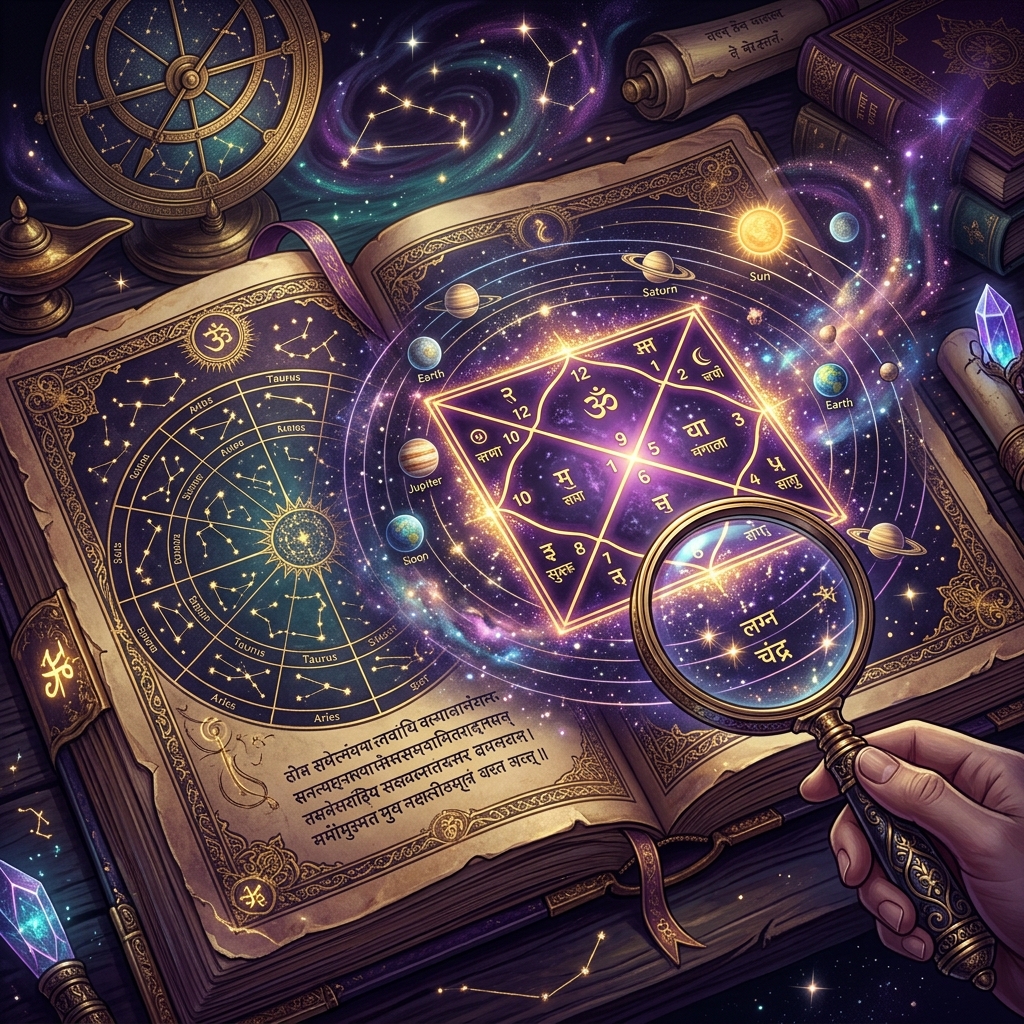
Vedic astrology uses 16 divisional charts (Shodashavarga) derived from the main birth chart. Each chart focuses on a specific life area:
- •**Navamsha (D-9)**: Marriage, dharma, and the soul's purpose. This is the most important divisional chart.
- •**Dashamsha (D-10)**: Career, profession, and public life
- •**Saptamsha (D-7)**: Children and creativity
- •**Drekkana (D-3)**: Siblings, courage, and short travels
- •**Chaturthamsha (D-4)**: Property, home, and fixed assets
Western astrology has no equivalent system. This gives Vedic analysis a depth of specificity that no other tradition matches for domain-level predictions.
Psychological Depth vs. Predictive Precision
Western astrology, particularly in its modern Jungian-influenced form, excels at psychological profiling. Concepts like the inner child, shadow work, and archetypal planetary energies make it a powerful therapeutic tool. Practitioners like Liz Greene and Stephen Arroyo have built entire counseling frameworks around it.
Vedic astrology is primarily a predictive science (*ganita jyotisha*). It is built for answering specific questions: Will I change careers this year? When is a favorable time to start a business? What does my marriage timeline look like? The mathematical precision of the Dasha system and divisional charts makes it the stronger tool for event-based forecasting.
Which System Should You Use?
It depends on your goal. Use Vedic astrology for: precise birth chart readings, event timing, marriage compatibility (Kundali Milan), career and financial cycles, and understanding karmic patterns. Use Western astrology for: psychological self-understanding, therapeutic exploration, archetypal analysis, and modern planetary cycles involving Uranus, Neptune, and Pluto.
Many serious astrology students eventually study both. But if you want to understand the *when* and *what* of your life with precision, Vedic astrology, with its 5,000-year mathematical tradition, is the more powerful tool for that purpose.
Frequently Asked Questions
Why is my Vedic Sun sign different from my Western Sun sign?
Because Vedic astrology uses the sidereal zodiac (based on actual star positions), while Western astrology uses the tropical zodiac (fixed to the seasons). Due to a 26,000-year wobble in Earth's axis called precession, the two zodiacs have drifted about 23 to 24 degrees apart. This shift usually moves a planet back one full sign.
Is Vedic astrology more accurate than Western?
Vedic astrology is generally considered more precise for life predictions because it uses the actual positions of constellations (sidereal), incorporates the Ascendant (Lagna) as heavily as the Sun sign, and has a sophisticated planetary period system (Dasha) for timing events. Western astrology excels in psychological profiling and modern therapeutic applications.
What is Ayanamsha in Vedic astrology?
Ayanamsha is the angular difference between the tropical and sidereal zodiacs. The most widely used is the Lahiri Ayanamsha (also called Chitrapaksha Ayanamsha), which is the official standard of the Indian government. As of 2026, the Lahiri Ayanamsha is approximately 24 degrees 07 minutes.
Do Vedic and Western astrology use the same planets?
Traditional Vedic astrology uses nine planets (Navagraha): Sun, Moon, Mars, Mercury, Jupiter, Venus, Saturn, Rahu, and Ketu. It does not use Uranus, Neptune, or Pluto. Western astrology uses all the outer planets. Some modern Vedic astrologers incorporate the outer planets but they are not part of classical Jyotish.